Free VIN Decoder & Vehicle Lookup
Instantly decode any vehicle's 17-character VIN. Get make, model, engine, drivetrain, 130+ specs and safety recalls, free, no signup required.
Find Your VIN
Locate the 17-character VIN on the dashboard (driver's side, visible through windshield), door jamb sticker, or vehicle title.
Enter & Decode
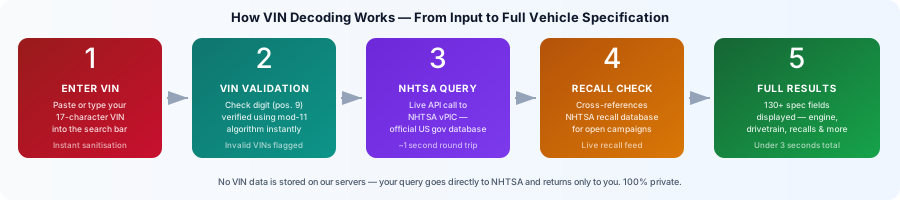
Type or paste your VIN above. Results load in under 2 seconds directly from the official NHTSA government database.
Get Full Specs
View make, model, engine, drivetrain, safety systems, manufacturing origin, and open safety recalls, all free.
Instant VIN Lookup, VIN Search & Online VIN Reader
When you run a VIN number lookup using our free online VIN decoder, our engine streams live data directly from NHTSA's vPIC database and OEM technical bulletins. In under three seconds, this online VIN reader returns forensic-level build data — engine code, engine size, transmission, drivetrain, build plant, and open safety recalls — for cars, trucks, trailers, motorcycles, and semitrailers built since 1981. Entirely free, no signup required. The tool covers VINs from the USA, Canada, Mexico, Europe, Japan, South Korea, and any country that uses the 17-character ISO 3779 standard.
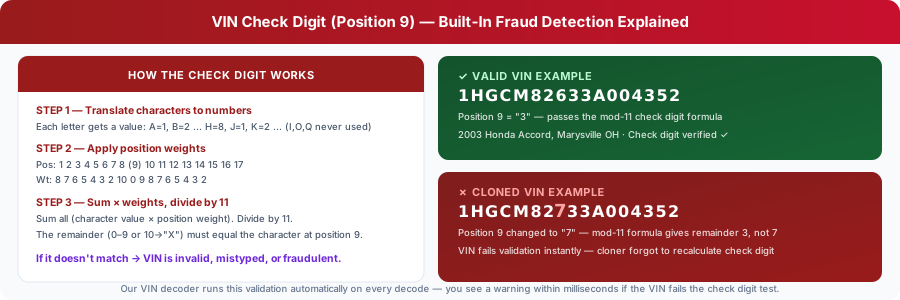
The built-in VIN validator also confirms the 9th-position check digit math automatically, so you can catch swapped or mathematically invalid VINs in seconds. Simply enter your VIN code in the search box above to see full results instantly.
Where to Find Your VIN Number
Your VIN appears in multiple locations on every vehicle. Check any of these 4 spots.
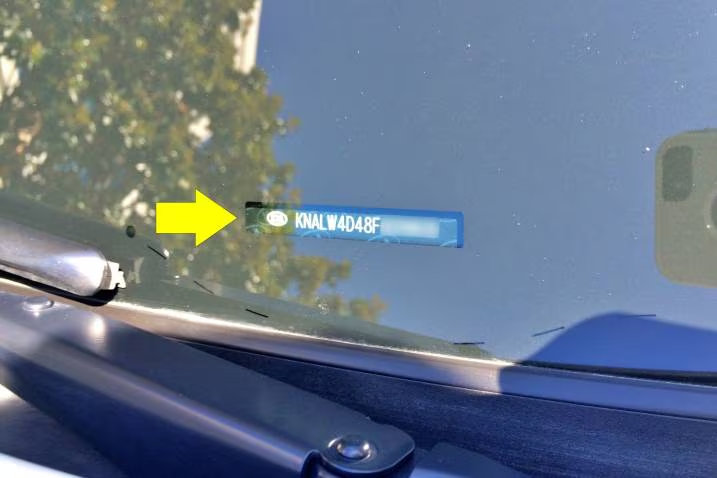
Look through the driver's side windshield corner at the dashboard. The most visible and commonly checked location.
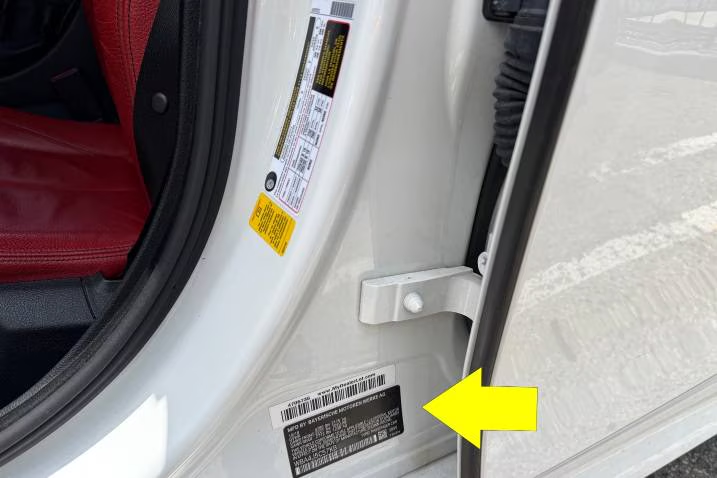
Open the driver's door and check the sticker on the door frame or B-pillar. Also shows GVWR and tire pressure.
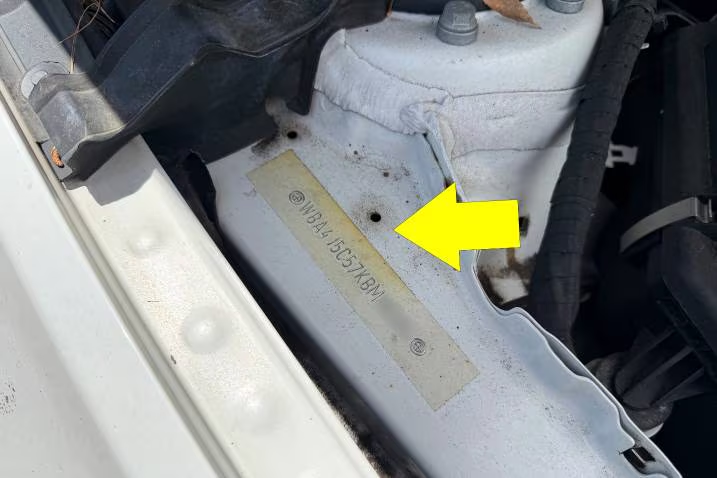
Stamped on the firewall or engine block. Useful for verifying the VIN hasn't been tampered with or replaced.
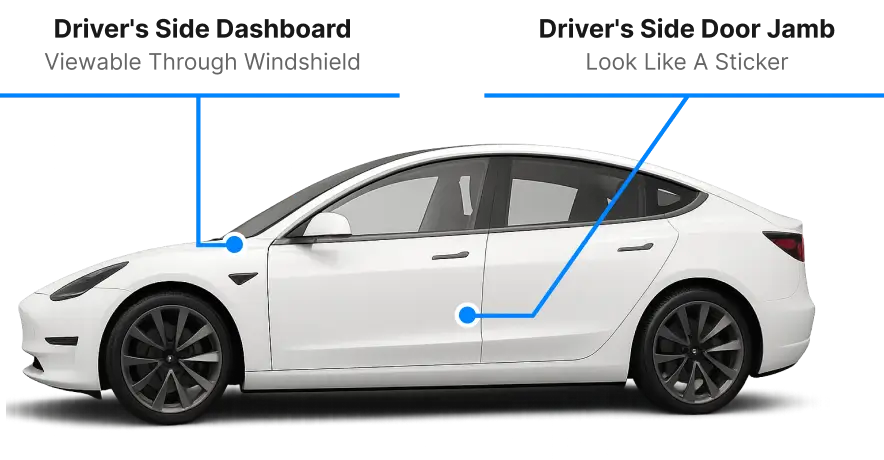
Your VIN is printed on your title, registration, and insurance card — handy when the vehicle isn't nearby.
VIN Decoder vs VIN Check — What's the Difference?
VIN Decoder / VIN Finder / VIN Reader / VIN Search / VIN Checker / VIN Locator / VIN Validator — all names for our free tool that gives you a full VIN breakdown: build specs and open recalls for the entire make-model-year. Perfect for fast research, including spotting "Split Year" anomalies like the 2007 Silverado "Classic". The built-in VIN validator confirms the 9th-position check digit math, so you can catch swapped or invalid VINs in seconds.
A VIN Check / Full History Report digs deeper: title brands, odometer timeline, lien records, auction photos, and prior sale prices. Run it before buying any used vehicle. VIN cloning fraud — where the Check Digit (position 9) doesn't match the VIN's math — is easier to catch than you'd think with our free built-in validator.
| Feature | Free VIN Decoder | Full History Report |
|---|---|---|
| Factory specs & build plant | ✔ Included | ✔ Included |
| Open safety recalls | ✔ Included | ✔ Included |
| Engine, drivetrain & transmission | ✔ Included | ✔ Included |
| VIN check digit validation | ✔ Included | ✔ Included |
| Title brands & salvage history | — Not included | ✔ Included |
| Odometer timeline & rollback flags | — Not included | ✔ Included |
| Accident & collision damage records | — Not included | ✔ Included |
| Lien & theft records | — Not included | ✔ Included |
| Auction photos & prior sale prices | — Not included | ✔ Included |
| Cost | $0 — Always Free | Low one-time fee |
Decode by Brand
Brand-specific VIN guides with WMI codes, model details, and assembly plant information.





Decode by Vehicle Type
Specialized decoders for every vehicle type, motorcycles, RVs, trailers, ATVs, boats, and classic cars.
Motorcycles
Decode any motorcycle or powersport VIN
RVs & Motorhomes
Motorhome, travel trailer, and camper VINs
Trailers
Utility, cargo, and boat trailer VINs
Classic Cars
Vintage vehicle VIN decoding guide
Electric Vehicles
Tesla, Rivian, and EV VIN articles
Free VIN Check
What a free VIN check reveals
Video Guide: How to Decode a VIN Number
Watch our step-by-step VIN decoding walkthrough — covers where to find your VIN, how to read each position, how to spot a cloned VIN, and how to use our free decoder to pull factory specs and live recall data in under three seconds.
Free VIN Tools
More ways to use your VIN for free vehicle information.
What Each VIN Position Means, A Complete Guide
A Vehicle Identification Number is not random. Every one of the 17 characters encodes a specific piece of manufacturer-submitted data. Here is exactly what each position tells our decoder, and you.
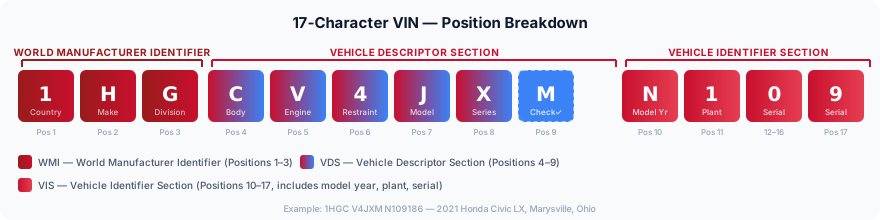
| Position | Section | What It Encodes | Example |
|---|---|---|---|
| 1 | WMI | Country of manufacture | 1 = USA · J = Japan · W = Germany · K = South Korea |
| 2 | WMI | Manufacturer / make | H = Honda · F = Ford · T = Toyota · G = General Motors |
| 3 | WMI | Vehicle type or division | Completes the World Manufacturer Identifier (1 to 3 = unique brand code) |
| 4 to 8 | VDS | Body style, engine type, restraint system, model line | 4 = body class · 5 = engine displacement & config · 6 = restraint/airbags · 7 to 8 = model/trim |
| 9 | VDS | Check digit (mathematical verification) | Calculated from positions 1 to 8 and 10 to 17 using a weighted mod-11 formula. Validates the VIN. |
| 10 | VIS | Model year | M = 2021 · N = 2022 · P = 2023 · R = 2024 · S = 2025 · T = 2026 |
| 11 | VIS | Assembly plant code | Each manufacturer assigns plant codes. Honda 1 = Marysville, OH; Toyota A = Tahara, Japan |
| 12 to 17 | VIS | Sequential production / serial number | Unique number for this specific vehicle off the production line. 6 digits, typically numeric. |
What a Free VIN Check Reveals, and What It Doesn't
Understanding the difference between a VIN decode and a full vehicle history report prevents expensive surprises. Our free decoder uses NHTSA data, the most accurate factory specification source available. Here is a clear breakdown of what you get, and what requires a paid service.
What a Free VIN Decode Reveals
What Requires a Paid History Report
Common VIN Myths Debunked
Misinformation about VINs is widespread online. These five myths lead buyers to overpay, skip important checks, or trust incomplete data. Here is the accurate picture for each.
-
MYTHA VIN decode tells you the car's full history.A VIN decode returns factory specification data submitted by the manufacturer at the time of production. It does not include accident history, title brands, odometer records, or ownership changes. For history, you need Carfax, AutoCheck, or a similar paid report in addition to the free decode.
-
MYTHThe VIN reveals the exact colour and options fitted to this car.The NHTSA database contains class-level factory data, not individual vehicle option codes. Colour, package options, and dealer-installed equipment are not stored in the vPIC database. For original factory options, you need the Monroney label (window sticker) or manufacturer portals.
-
MYTHSharing a VIN lets someone steal your vehicle identity.A VIN is a public identifier, it appears on your dashboard in plain view and on every official document. Sharing a VIN for a pre-purchase check is normal and encouraged. The security risk is VIN cloning, where a stolen vehicle is re-tagged with a legitimate VIN, which is why cross-checking all four physical VIN locations matters.
-
MYTHFree VIN decoders are less accurate than paid services.For factory specification data, a free decoder using the official NHTSA vPIC API (like Full VIN Lookup) is equally accurate, or more so, than paid services, because all services query the same government database. Paid services add value through accident history and title records, not through better spec data.
-
MYTHAll 17 VIN characters contain unique vehicle information.Position 9 is a mathematical check digit, calculated from the other 16 characters using a weighted mod-11 formula. It does not encode vehicle-specific data; it exists solely to detect VIN transcription errors or fraudulent number generation. If position 9 doesn't validate, the VIN is invalid.
When to Run a VIN Check, Key Use Cases
A VIN decode takes under two seconds and is free. Here are the situations where running one before you act can save significant time, money, or legal trouble.
-
1Buying a Used Vehicle
Decode the VIN before viewing the car to confirm the advertised specs, engine size, drivetrain, trim, match what is actually fitted. Discrepancies between the listing and the NHTSA data are a red flag for odometer fraud or spec substitution.
-
2Checking for Open Safety Recalls
NHTSA maintains a live recall database tied to each VIN. A free decode surfaces any open recall campaigns. An unaddressed recall means the manufacturer is obligated to repair the vehicle free of charge, but only if you know about it.
-
3Ordering the Correct Parts
Auto parts retailers use the VIN to identify the exact engine, transmission, and body configuration. Two vehicles of the same model year can have different engines depending on the trim. Decoding the VIN first ensures you order parts that fit your specific vehicle build.
-
4Insurance Quotes & Coverage Verification
Insurers use VINs to pull exact vehicle specs for accurate quote calculations. When shopping for cover, having your VIN decoded first lets you cross-check that the insurer's system has the correct body style, engine, and safety equipment on file, errors lead to incorrect premiums or claim disputes.
-
5Vehicle Import & Export Compliance
The country-of-manufacture code (VIN position 1) and manufacturer code (positions 1 to 3) are required for customs declarations and import duties. The assembly plant code (position 11) confirms the actual build location, which can differ from the country of origin for tariff purposes.
-
6Identifying a Classic or Vintage Vehicle
Pre-1981 vehicles used manufacturer-specific VIN formats rather than the standardised 17-character ISO standard. Our classic car VIN guide explains how to decode older formats by marque, including early Ford, GM, and Chrysler models whose VINs encode the model, year, and plant differently.
VIN Fraud, Cloning & How to Protect Yourself Before You Buy
VIN fraud costs US car buyers hundreds of millions of dollars every year. Understanding the most common schemes — and how to detect them in under five minutes — is the single best thing you can do before handing over money for a used vehicle.
-
VIN Cloning A thief copies a legitimate VIN from an identical vehicle and re-tags a stolen or salvage-titled car with it. The fastest detection: our free decoder runs the 9th-position check digit algorithm automatically. A failed check digit means the VIN is mathematically invalid — stop right there.
-
Title Washing A salvage or flood title is "washed clean" by re-registering across multiple states, erasing the brand. The NHTSA vPIC data won't reveal this — a paid history report will show title brands across all states. If the price seems too good, check the title brand first.
-
Odometer Fraud Rollbacks leave no trace in free factory-spec data. A paid history report compares odometer snapshots across DMV records, auctions, and inspection reports over the vehicle's lifetime. Always cross-check mileage before buying privately.
-
Check the Rosette Rivets On the dashboard VIN plate, "Rosette" (daisy-shaped) rivets are OEM standard on US vehicles. Round or hex screws are a red flag for a swapped plate. Always inspect physically — a cloner can reprint the sticker but often uses the wrong fasteners.
-
Cross-Check All Four VIN Locations Dashboard, driver's door jamb, engine firewall stamp, and frame rail stamp must all match. On muscle cars, look for the "Confidential VIN" stamped on the firewall or frame rails — cloners frequently miss this secondary stamp.
-
Run the Free Check Digit Validator Our decoder validates position 9 instantly. A valid check digit doesn't guarantee authenticity, but a failed one guarantees a problem. For motorcycle VINs, also check the steering neck below the handlebars; for semitrailers, the left front of the trailer frame.
What Vehicle Specs Can a VIN Reveal?
Our free VIN decoder pulls a full factory specification sheet from any 17-digit VIN, the same data manufacturers and DMVs use for vehicle verification. Here is the complete list of what you can get from a VIN search:
-
Engine Size by VIN Displacement, configuration (I4, V6, V8) and engine code, all encoded at position 8 of the VIN.
-
Drivetrain & AWD Detection Whether the vehicle is AWD, 4WD, FWD or RWD, decoded straight from the VIN without needing to look under the vehicle.
-
Wheelbase & Body Style Body class (sedan, SUV, pickup, van, coupe) and wheelbase in mm, how to find wheelbase with a VIN, answered instantly.
-
Transmission Type Automatic, manual, CVT or DCT, where coded by the OEM in their NHTSA submission.
-
Fuel Type & Flex-Fuel Status Gasoline, diesel, hybrid, EV, or flex-fuel (E85) capability, including full battery electric and plug-in hybrid systems.
-
GVWR & Trim Level Gross Vehicle Weight Rating and factory trim designation, useful for towing calculations and parts ordering.
-
Horsepower Rating Engine output in hp, where submitted to NHTSA by the manufacturer. Some trim variations may report the base engine only.
-
Primary Restraint Systems Airbag locations (front, side, curtain, knee), seatbelt type, and crash management system codes.
-
Build Plant & Country of Origin The WMI (first three characters) shows who built the vehicle and where. Position 11 pinpoints the exact assembly plant.
-
Manufacturer Name Full legal manufacturer name, useful for distinguishing subsidiaries (e.g., "Honda of America Manufacturing" vs. "Honda Motor Co., Ltd.").
-
Open Safety Recalls Any active NHTSA recall campaigns tied to this make-model-year, so you know before you buy whether there is a free manufacturer repair outstanding.
-
130+ Additional Specification Fields Brake type, steering, bed length (trucks), number of seats, error and entertainment systems, the complete NHTSA vPIC data set.
VIN Model Year Codes 1980 to 2035, Complete Reference Table
The 10th character in a VIN indicates the model year. The letters I, O, Q, U, and Z are excluded. From 2001 to 2009, digits replaced letters, restarting with A in 2010.
| Code | Year | Code | Year | Code | Year | Code | Year |
|---|---|---|---|---|---|---|---|
| A | 1980 | L | 1990 | Y | 2000 | A | 2010 |
| B | 1981 | M | 1991 | 1 | 2001 | B | 2011 |
| C | 1982 | N | 1992 | 2 | 2002 | C | 2012 |
| D | 1983 | P | 1993 | 3 | 2003 | D | 2013 |
| E | 1984 | R | 1994 | 4 | 2004 | E | 2014 |
| F | 1985 | S | 1995 | 5 | 2005 | F | 2015 |
| G | 1986 | T | 1996 | 6 | 2006 | G | 2016 |
| H | 1987 | V | 1997 | 7 | 2007 | H | 2017 |
| J | 1988 | W | 1998 | 8 | 2008 | J | 2018 |
| K | 1989 | X | 1999 | 9 | 2009 | K | 2019 |
| L | 2020 | ||||||
| M | 2021 | ||||||
| N | 2022 | ||||||
| P | 2023 | ||||||
| R | 2024 | ||||||
| S | 2025 | ||||||
| T | 2026 | ||||||
| V | 2027 | ||||||
| W | 2028 | ||||||
| X | 2029 | ||||||
| Y | 2030 | ||||||
| 1 | 2031 | ||||||
| 2 | 2032 | ||||||
| 3 | 2033 | ||||||
| 4 | 2034 | ||||||
| 5 | 2035 |
⚠️ 2007 Split Year Trap: The code 7 covers model year 2007, but GM produced "2007 Classic" versions of some trucks, these carry the same code as regular 2007 models. Always cross-reference trim data if you're evaluating a 2007 Silverado or Sierra. Letters I, O, Q, U and Z are never used in any VIN position.
WMI Country & Manufacturer Codes, VIN Position 1 to 3 Reference
The first three characters of any VIN form the World Manufacturer Identifier (WMI), a globally unique code that identifies the manufacturing entity and country. There are over 48,000 registered WMI codes. The continent-sorted table below covers the most common ranges and exposes "parentage anomalies", like the Austrian-built Toyota Supra or the Alabama-assembled Mercedes.
| WMI Range | Region / Country | Notes & Key Manufacturers |
|---|---|---|
| AA to AH | Africa, South Africa | AA = Ford SA · AB = Toyota SA · AC = Nissan SA |
| J | Asia, Japan | JA = Isuzu · JF = Fuji (Subaru) · JH = Honda · JM = Mazda · JN = Nissan · JT = Toyota |
| KL to KR | Asia, South Korea | KL = Daewoo/GM Korea · KM = Hyundai · KNA = Kia |
| L | Asia, China | LVS = Volvo China · LDC = Dodge China · Various domestic brands |
| MA to ME | Asia, India | MA3 = Suzuki India · MAL = Hyundai India |
| MF to MK | Asia, Indonesia | MHF = Toyota Indonesia |
| ML to MR | Asia, Thailand | MNT = Toyota Thailand · MR0 = Isuzu Thailand |
| SA to SM | Europe, United Kingdom | SAL = Land Rover · SAR = Rolls-Royce · SCC = Lotus · SCE = Aston Martin · SFD = Leyland · SJN = Nissan UK |
| SN to ST, W | Europe, Germany | WBA = BMW · WBS = BMW M · WDB = Mercedes-Benz · WDD = Mercedes · WDC = Mercedes SUV · WF0 = Ford Germany · WP0 = Porsche · WVW = Volkswagen · W1K = Austrian Supra (GR Supra) |
| SU to SZ | Europe, Poland | SUF = Fiat Poland · SUL = Solaris |
| VF to VR | Europe, France | VF1 = Renault · VF3 = Peugeot · VF7 = Citroën |
| VS to VW | Europe, Spain | VSS = SEAT · VSK = Nissan Spain |
| YA to YE | Europe, Belgium | YAR = Volvo Belgium |
| YF to YK | Europe, Finland | YK1 = Saab Finland |
| YS to YW | Europe, Sweden | YS3 = Saab Sweden · YV1 = Volvo Sweden |
| ZA to ZR | Europe, Italy | ZAM = Maserati · ZAR = Alfa Romeo · ZCF = Iveco · ZFA = Fiat Italy · ZFF = Ferrari · ZHW = Lamborghini |
| 1, 4, 5 | North America, USA | 1FA = Ford USA · 1G = GM · 1HG = Honda USA · 1N4 = Nissan USA · 1VW = VW USA · 4T1 = Toyota USA · 4US = BMW USA · 5TD = Toyota SUV USA |
| 2 | North America, Canada | 2G = GM Canada · 2HG = Honda Canada · 2T1 = Toyota Canada (Matrix vs. 1G Vibe) |
| 3 | North America, Mexico | 3FA = Ford Mexico · 3VW = VW Mexico · 3GY = Cadillac Mexico |
| 6A to 6W | Oceania, Australia | 6FP = Ford Australia · 6G1 = GM Holden |
| 9A to 9E, 93 to 99 | South America, Brazil | 9BF = Ford Brazil · 9BG = GM Brazil |
Note: The country code in the WMI reflects where the vehicle was manufactured, not the country of the brand's headquarters. A US-built BMW (4US/5UX) and a German-built BMW (WBA) are both BMWs, the WMI tells you which factory built yours. A German Supra (W1K) is actually Austrian-assembled (Magna Steyr plant).
About Our VIN Data Pipeline, Where the Information Comes From
Full VIN Lookup stitches together multiple government and industry data feeds. Here is exactly what each source adds and how frequently it updates.
| Data Feed | Source Type | What It Adds | Update Frequency |
|---|---|---|---|
| NHTSA vPIC & Recall APIs | U.S. Federal (open) | Factory specs, WMI verification, build plant, safety recalls | Live stream |
| OEM Technical Bulletins | Manufacturer portals | Service bulletins, common failure points, model year mismatch alerts | Daily refresh |
| Insurance & Auction Clearinghouses | Private aggregators | Total-loss flags, salvage dates, odometer snapshots | Daily |
| Warranty & Valuation DBs | Industry partners | In-service date, warranty status, MSRP & retail value | Live stream |
| Dealer-Reported Listings | Franchise & independent | Trim confirmation, option codes (Z28, M-Sport package verification) | Live stream |
Transparency & Compliance: Personal data is redacted per DPPA (Driver's Privacy Protection Act) and Canadian privacy laws. Full VIN Lookup is not a government agency, we aggregate and enrich public data so you can search it in one place. Always confirm critical facts with the seller, a licensed mechanic, or your DMV before purchase.
About Our Data: Full VIN Lookup uses the official NHTSA vPIC (Vehicle Product Information Catalog) API, the same database used by US government agencies, insurance companies, and automotive businesses. All vehicle specification data comes directly from manufacturer submissions to NHTSA. We do not store, resell, or share VINs you enter.
Frequently Asked Questions
Is Full VIN Lookup really free?
Yes — decoding factory specs and open recalls is completely free with no signup required. We query the official NHTSA vPIC API, a public US government service with no rate limits or premium tiers. A paid Full History Report is optional if you need lien, odometer, and title-brand data.
How do I check a VIN code?
Enter your 17-character VIN in the search box at the top of this page and click Decode. Our VIN number lookup tool returns factory specs, build plant details, and any open safety recalls in under three seconds. It also validates the 9th-position check digit automatically, catching oddities like the "Factory-Authorized Invalid VIN" on certain 2015 Jeep Renegades.
What information does a VIN decode return?
A VIN decode returns over 130 data fields from the NHTSA database including make, model, model year, body style, engine displacement and cylinder count, fuel type, horsepower, drivetrain (FWD/RWD/AWD/4WD), transmission type, GVWR, assembly plant city and country, manufacturer name, primary restraint systems, and open safety recall notices.
How accurate is the VIN decoder?
Our decoder queries the NHTSA vPIC database directly — the official US government vehicle information system. The data is as accurate as what manufacturers submitted to NHTSA at the time of production. For US-market vehicles manufactured after 1981, the data is highly accurate and complete. Some specialty trims may have partial data where the manufacturer's submission was incomplete.
Does VIN decoding show accident history?
No. The NHTSA vPIC database contains factory specification data only — it does not include accident history, title brands (salvage, flood), odometer records, or ownership history. For complete vehicle history, use a paid service like Carfax or AutoCheck in addition to our free decode.
Can I decode a VIN for any vehicle?
Yes, our decoder works for cars, trucks, SUVs, motorcycles, RVs, trailers, and other motor vehicles manufactured since 1981. Vehicles manufactured before 1981 used non-standard VIN formats and may not decode correctly. The NHTSA database is most complete for vehicles sold in the United States, but international VINs using the 17-character ISO 3779 standard also decode accurately.
Can I decode a pre-1981 VIN?
Older VINs use 11 to 13 characters and were never standardized, so automated results may be limited. For vintage muscle cars, look for engine codes like "J" (Hemi) or "R" (Cobra Jet Ram Air) by hand. Our classic car VIN guide explains decoding by marque for pre-1981 Ford, GM, and Chrysler vehicles.
What if my VIN shows an O or I?
The letters I, O, and Q are never used in modern VINs. Double-check — it is almost certainly a zero (0) or the number one (1). Worth knowing: VIN cloners often alter digits but forget to recalculate the 9th-position check digit, which is why our validator catches so many fakes.
How do I find the engine size, wheelbase or AWD status from a VIN?
Engine size, displacement, and engine code are encoded at position 8 of the VIN and decoded automatically by our tool. Wheelbase, drivetrain (AWD, 4WD, FWD, RWD), and body class come from the manufacturer's vPIC submission to NHTSA. Just enter your 17-digit VIN in the search box above to see engine size by VIN, wheelbase, AWD/4WD status, and the complete factory spec sheet.
What is a VIN validator and how does it catch fakes?
A VIN validator runs a weighted mod-11 check-digit algorithm on position 9 of any North American VIN. The math must match the other 16 characters — if it doesn't, the VIN was either mistyped or tampered with. Our online VIN checker runs this validation automatically, so you know within seconds whether a VIN is mathematically legitimate. It is the fastest way to spot a cloned or swapped VIN before you buy.
Does the tool work for trailers, trucks, and motorcycles?
Yes. Our trailer VIN lookup, truck VIN decoder, and motorcycle VIN search all use the same engine. For trailers, the VIN is usually on the left front of the trailer frame. For motorcycles, it is on the steering neck below the handlebars. For semi-tractors and heavy trucks, check the driver-side door jamb. Enter any 17-character VIN to see GVWR, axle config, body class, and open safety recalls.
Does this VIN decoder work for Canada, Europe, and other countries?
Yes. Our free VIN decoder works for VINs issued in Canada, the USA, Mexico, Europe (Germany, UK, France, Italy, Spain), Japan, Korea, Brazil, South Africa, and more — anywhere that uses the 17-character ISO 3779 standard. The first three characters (the WMI) identify the country of origin, so a Canadian-built Toyota (2T1) decodes just as easily as a US-built one (4T1) or a Japanese-built one (JTD).
How often is your data updated?
NHTSA vPIC and safety-recall feeds stream live — every query hits the government API in real time. OEM technical bulletins refresh daily. This means specs and recall status are always current, never served from a stale snapshot.
Can a VIN tell me the trim level?
Yes, where the manufacturer submitted trim data to NHTSA. Positions 4 through 8 (the Vehicle Descriptor Section) encode body style, engine type, restraint system, and trim series. Our decoder displays the trim series exactly as NHTSA received it. Note that some manufacturers use generic VDS codes across multiple trims, so cross-reference with the window sticker for definitive trim confirmation.
Is personal data in a VIN report legal to share?
Yes. All personal identifiers are removed under the Driver's Privacy Protection Act (DPPA) and Canadian privacy rules. VIN reports reveal only vehicle-related facts and manufacturing provenance — owner names, addresses, and personal information are never included or displayed.